Monday, May 9, 2011
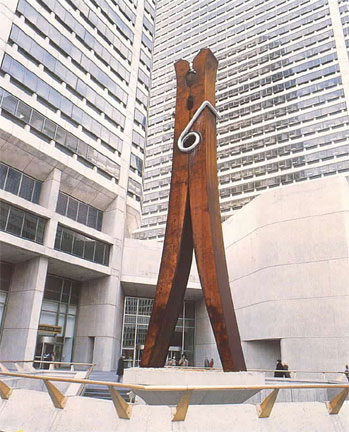
Giant Clothespins?
When I first saw Claes Oldenburg's "Clothespin" I was fairly skeptical about it's place in the humanities book. It didn't seem overly impressive and I thought surely they could find a better topic to talk about that was relative to the subject. But, like it seems I always do, I sort of opened up to it after reading about it and thinking a little deeper on it.
 After my initial Pollock-like impression had faded, I started to appreciate this form of art for what it was intended; comedy. Oldenburg wasn't necessarily trying to be overly creative with this but rather make us think twice about something we normally hardly think once about. What I took from this piece was that something, in this case a clothespin, isn't always used for how we think it should, hanging up clothes. And what better way than to get that point across then making it absurdly giant? I know I can't think of a better way. Unless you are Paul Bunyan, you won't be using this size of clothespin anytime soon for laundry. So bravo Mr. Oldenburg, you get my approval on this one. Plus you get the honor of being my last blog so kudos to you.

Tourists
As I was flipping through the text book looking for something to blog on, I stopped on the page with what a picture that looked like my grandma and grandpa. After I got over the resemblance, I started to question why was there a picture of two elderly people in a room? That's not art. It can't be art. As I read the section explaining the picture I discovered it wasn't actually two living people but rather life-like mannequin art thingies.
 This changed my perspective a bit. While it may not be the stereotypical painting that invokes deep meaning, it certainly can give the mind a little workout. As we've discussed different pieces over the semester, we always seem to talk about how the artist makes his piece come to life. Well what better way than make it actually look alive? Using fiberglass, clothes, and wigs, Hanson made his artwork as alive as he possibly could. Plus he made it easier for the viewer, or at least for me, to feel the life of his work. It doesn't make you question the deep interlying meaning for hours on end, but for at first glance you can truly appreciate this artwork as if it were alive and part of your everyday life. I know my grandparents would be proud of it.

Monday, April 25, 2011
Damien Hirst
I figured I should get one more blog in about the text book before finishing with the House of the Spirits, and once I saw Damien Hirst's art I knew that was what I should blog about. His "The Physical Impossibility of Death in the Mind of Someone Living" was a piece that truly got me thinking, much more than perhaps any other piece of art we have discussed so far this semester.
 One of the first thoughts that came to mind was the way that Hirst was able to capture the horror of a creature that is known for its dangerous and ferocious and yet still find a way to bring that to display. Even though the shark is dead and cannot physically harm us, I sort of feel that the sense of fear still remains with the shark. The way that the shark has been placed with its mouth wide open as if it was about to strike its prey sends tingle down the observers spine. I feel that Hirst did an excellent job conveying that sense and allowing the public to witness that.
Another impression I got from this piece is that Hirst might have been conveying that death in itself is its own form of art. There doesn't have to be life in a work to be art, or maybe a better way of saying it is death brings life. If the shark was still alive and swimming freely in its box (or as free as a shark can swim in a small box), that would not give off the same artistic feel that a deceased shark would. Perhaps the reason is that a dead shark cannot rearrange its position, thus permanently freezing it in the desired position. Whatever the explanation, I feel that this reason is why I enjoyed this piece so much.

Another impression I got from this piece is that Hirst might have been conveying that death in itself is its own form of art. There doesn't have to be life in a work to be art, or maybe a better way of saying it is death brings life. If the shark was still alive and swimming freely in its box (or as free as a shark can swim in a small box), that would not give off the same artistic feel that a deceased shark would. Perhaps the reason is that a dead shark cannot rearrange its position, thus permanently freezing it in the desired position. Whatever the explanation, I feel that this reason is why I enjoyed this piece so much.
Monday, April 18, 2011
Op Art Sensation
As I was reading through the text book, Bridget Riley's "Current" on page 139 stood out to me. Before even reading the section about it, my mind jumped backed to 6th grade when we learned about optical illusions and such. When I read what Op Art was all about, I found the concept really interesting. Like most pieces of art, what a person sees is truly in the eye of the beholder, but here it isn't as much as what you see as how you see it.
 What I took out most from this piece, or perhaps even the whole style of op art, was that any artist or person can give someone a picture, but they cannot tell them what to do with it. It is up to the viewer to decide what to make of it. With op art, to adequately determine what to make of the art you have to look at it in your own special way (even though that sounds kind of cheesy in a sense). For example when I look at this piece above, I see a valley with two parallel streams running through it. It's kind of hard with this picture because the lines are bigger but if you look in the book you might see what I'm getting at.

Another aspect of op art that I found fascinating was its capabilities to make it look like the piece has movement within it. When you stare at an op art piece long enough, the lines seem to vibrate or move ever so slightly. I think that gives the art a sense of added life. Sure, technically it isn't moving and will never really move, but just the sense that it appears to be moving is enough. Op art to me contains more life within it than most other works of art that we have studied so far.
Another aspect of op art that I found fascinating was its capabilities to make it look like the piece has movement within it. When you stare at an op art piece long enough, the lines seem to vibrate or move ever so slightly. I think that gives the art a sense of added life. Sure, technically it isn't moving and will never really move, but just the sense that it appears to be moving is enough. Op art to me contains more life within it than most other works of art that we have studied so far.
Monday, March 7, 2011
Art. So easy, Jackson Pollock could do it

When I first looked at Jackson Pollock’s Lavender Mist on page 87, I couldn’t help but say to myself sorry Mr. Pollock, but you’ll have to try again. At least make an attempt to make your randomness look like something distinguishable. At first I thought it was one of those pictures where if you look at it in just the right way long enough, a figure kind of jumps out at you. But alas, it was not.
Perhaps I am looking at his art the wrong way. Pollock claimed that each of his paintings had a life of its own and that he simply controlled its direction. While that is fine and dandy, I still think that an artist can give life to their painting by displaying a piece that is semi-recognizable. I actually really like the concept of action painting where the artist walks around on his/her own painting. It gives the physical sense that the maker is truly part of his creation, but that does not mean you can just slop down paint and let its uncertainty find its place for it. Gravity controls just as much as Pollock does in that case.

While I feel kind of bad ripping on the guy, especially since he is one of the few people we’ve read about that I knew of before this class started, I just don’t appreciate his style of art. I don’t feel that it takes much talent and while some may say it is incredibly creative, I feel it lacks creativeness. My 4 year old nephew recently drew, scribbled may be a better word, me a picture of a mama duck and 3 baby ducks. While you probably never would have knew what it was if he didn’t tell you, it sort of reminded me of Pollock’s work; kind of random and just color everywhere. Perhaps my nephew is an artistic genius and I have his best masterpiece yet. Let the bidding start at $10,000.
Wednesday, February 23, 2011
Wrath of Pablo
I have to admit, most of the art pieces we have observed and discussed so far in class haven't really stood out as truly significant to me. However, when I take a look at Pablo Picasso's Guernica I cannot help but try to immerse myself into the piece. While most of Picasso's paintings are extremely abstract (and I suppose this one is too) I feel as if the significance and meaning are clearly displayed in this masterpiece.

Portraying the horrors of war, particularly the bombing of the Spanish town of Guernica, Picasso uses his typical cubist style to show suffering in an almost grueling manner. While often times Picasso would paint people with certain disfigurations without offering a true meaning, there is no doubt these hideous traits in this piece symbolize the pain they are going through. The women on the right with the swollen leg has clearly been physically crushed by war. Each abstract person resembles that of someone who has been traumatized by the horrors that the conflict of governments can have.
And while the point of this particular piece may have been more clear cut than most of Picasso's work, or at least I feel that it was, I think that only strengthens the impact that this piece has on society. While all of Picasso's art no doubt represents some sort of feeling he had, sometimes it can be difficult to interpret. For this piece he clearly wanted to express his opinions on war and personally I think he did an excellent job. Just glancing at the picture almost gives me chills. I liked the quote the book included, saying that this art was "a weapon against the enemy." While I assume that "enemy" is war, that could be a whole other discussion in itself. But what I am fairly certain of is Picasso's displeasure in the toils of war, and I for one feel this piece of art did a pretty darn good job of showing that.

Portraying the horrors of war, particularly the bombing of the Spanish town of Guernica, Picasso uses his typical cubist style to show suffering in an almost grueling manner. While often times Picasso would paint people with certain disfigurations without offering a true meaning, there is no doubt these hideous traits in this piece symbolize the pain they are going through. The women on the right with the swollen leg has clearly been physically crushed by war. Each abstract person resembles that of someone who has been traumatized by the horrors that the conflict of governments can have.
And while the point of this particular piece may have been more clear cut than most of Picasso's work, or at least I feel that it was, I think that only strengthens the impact that this piece has on society. While all of Picasso's art no doubt represents some sort of feeling he had, sometimes it can be difficult to interpret. For this piece he clearly wanted to express his opinions on war and personally I think he did an excellent job. Just glancing at the picture almost gives me chills. I liked the quote the book included, saying that this art was "a weapon against the enemy." While I assume that "enemy" is war, that could be a whole other discussion in itself. But what I am fairly certain of is Picasso's displeasure in the toils of war, and I for one feel this piece of art did a pretty darn good job of showing that.
Friday, February 11, 2011
A Bug's Life

Kafka's insecurity in many of his works may have been a tad unfounded since he the author of acclaimed work, but I feel that this sense of insecurity can be detected in the way he writes. In this particular piece and as I hinted to earlier, while Gregor Samsa does not forget he has transformed into a giant insect he really doesn't seem all that concerned up until he has to unlock his door. Instead all the thoughts and worries of his job, getting to the train station on time, and how chief was going to be upset with him. I can sense the feeling of insecurity in Kafka's character, almost as if Kafka is portraying himself as the character.
But perhaps the most defining moment of insecurity in the "The Metamorphosis" is located in the last paragraph of the excerpt in the book. Just moments after Mr. Samsa seems to experience his moment of relief, his family looks upon him as if he is nothing more than he appears, an unwelcome insect.
"His mother - in spite of the chief clerk's directions - first clasped her hands and looked at his father, then took two steps towards Gregor and fell on the floor among her outspread skirts, her face quite hidden on her breasts. His father knotted his fists with a fierce expression on is face as if he meant to knock Gregor back into his room"
We are brought up believing that no matter how bad things get, one's family will be there to support you no matter what. This lack of understanding from Kafka's imaginary family I feel shows the true insecurities he had in his life.

Subscribe to:
Posts (Atom)