Monday, May 9, 2011
Giant Clothespins?
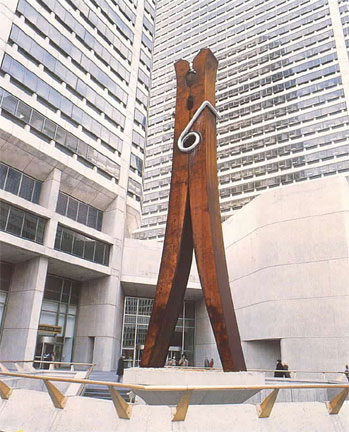
When I first saw Claes Oldenburg's "Clothespin" I was fairly skeptical about it's place in the humanities book. It didn't seem overly impressive and I thought surely they could find a better topic to talk about that was relative to the subject. But, like it seems I always do, I sort of opened up to it after reading about it and thinking a little deeper on it.
 After my initial Pollock-like impression had faded, I started to appreciate this form of art for what it was intended; comedy. Oldenburg wasn't necessarily trying to be overly creative with this but rather make us think twice about something we normally hardly think once about. What I took from this piece was that something, in this case a clothespin, isn't always used for how we think it should, hanging up clothes. And what better way than to get that point across then making it absurdly giant? I know I can't think of a better way. Unless you are Paul Bunyan, you won't be using this size of clothespin anytime soon for laundry. So bravo Mr. Oldenburg, you get my approval on this one. Plus you get the honor of being my last blog so kudos to you.

Tourists
As I was flipping through the text book looking for something to blog on, I stopped on the page with what a picture that looked like my grandma and grandpa. After I got over the resemblance, I started to question why was there a picture of two elderly people in a room? That's not art. It can't be art. As I read the section explaining the picture I discovered it wasn't actually two living people but rather life-like mannequin art thingies.
 This changed my perspective a bit. While it may not be the stereotypical painting that invokes deep meaning, it certainly can give the mind a little workout. As we've discussed different pieces over the semester, we always seem to talk about how the artist makes his piece come to life. Well what better way than make it actually look alive? Using fiberglass, clothes, and wigs, Hanson made his artwork as alive as he possibly could. Plus he made it easier for the viewer, or at least for me, to feel the life of his work. It doesn't make you question the deep interlying meaning for hours on end, but for at first glance you can truly appreciate this artwork as if it were alive and part of your everyday life. I know my grandparents would be proud of it.

Subscribe to:
Posts (Atom)